

On your way out the door, you close the kids’ rooms so the mess is out of sight. You shut the guest room nobody’s used since the holidays. You pull your own bedroom door shut on the way past, figuring the cool air will settle where you want it. It’s a small routine most of us run without thinking, and it feels like a smart way to keep the house comfortable.
But does closing doors actually help with AC performance, or does it quietly work against your system? In most homes, a closed door does more harm than good. It interrupts the path your conditioned air needs to travel back to the unit. Over a DFW cooling season that runs close to seven months, that extra strain adds up.
The Airflow Basics at a Glance
- Closed interior doors block the return-air path, which forces your AC to work harder to move the same amount of air
- Rooms behind closed doors can feel warmer or stuffier while the rest of the house feels drafty
- You can restore proper airflow without leaving every door wide open all day
- Fixes range from simply cracking doors to under-door gaps, transfer grilles, and dedicated returns
- Some fixes are DIY; others call for a licensed HVAC technician
How Closed Doors Disrupt Your Home’s Airflow
Most central AC systems push conditioned air out through supply registers in every room. That air is supposed to circulate back to a central return, usually located in a hallway or common area.
When you close a bedroom door, supply air keeps flowing in, but the return path is cut off. Pressure builds inside the room and drops across the rest of the house. That imbalance forces air to escape through gaps around windows, outlets, and framing, and it can pull warm, unconditioned air in from the attic.
Your return ducts and plenum are what move air back to the system, so blocking their access throws the whole loop off balance. The blower then works harder against the added pressure, which raises energy use and system wear.
Signs Closed Doors Are Restricting Your Cooling
A few patterns tend to show up once doors start choking off airflow:
- A closed-off bedroom stays warmer or stuffier than the rest of the house
- You hear air whistling through the gap under a door
- Temperatures swing noticeably from one room to the next
- The system runs longer to reach the same thermostat setting
If one room is consistently the odd one out, our guide on why one room in your DFW home is always hotter than the rest breaks down the usual culprits. And if a faint whistle under a door has you worried, it’s one of several quirks covered in our roundup of HVAC behaviors that look scary but are completely normal.
Simple Ways to Restore Airflow Without Leaving Doors Open
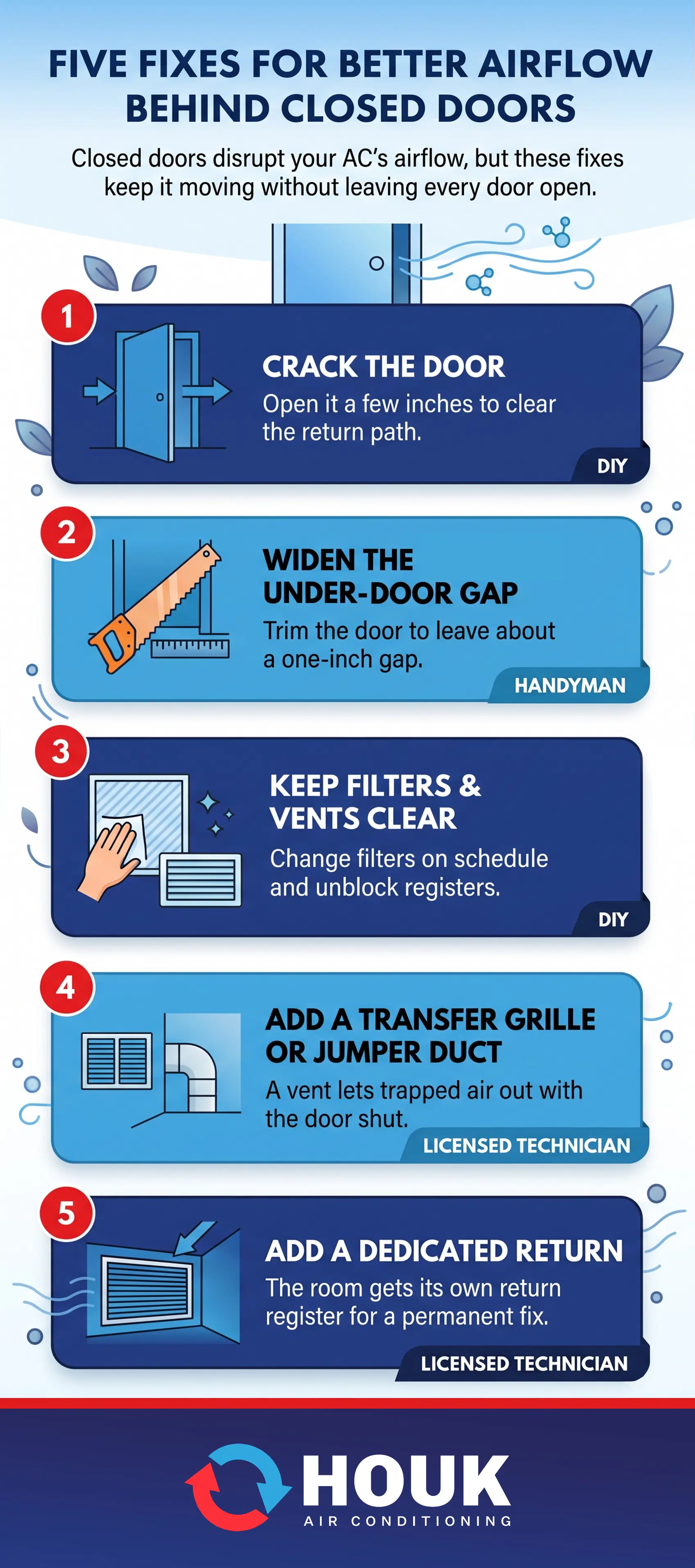
Knowing how to fix airflow problems in AC system layouts comes down to one goal: give return air a clear path back to the unit. Most solutions are affordable, and several are things you can handle yourself.
Leave Doors Cracked Instead of Fully Closed
The easiest option is also free. Leaving a door open a few inches keeps the return path clear while still giving the room privacy and quiet.
The fix: Crack interior doors during the day to relieve pressure. No tools or technician required.
Undercut the Door for a Larger Air Gap
Standard doors leave a small gap at the bottom, but it’s often too narrow for the volume of supply air entering the room. Trimming the door to leave roughly a one-inch gap lets more air slip back toward the return.
The fix: Add or widen the under-door gap to restore return flow. A handyman can handle this; an HVAC technician is not required
Keep Filters Clean, Vents Clear
Closed doors aren’t the only thing that starves an AC of airflow. A clogged filter or furniture pushed against a supply vent creates the same strain. ENERGY STAR recommends checking your filter monthly and changing it at least every three months, since a dirty filter slows airflow and makes the system work harder. Keep registers unblocked and pair that with routine AC maintenance to keep airflow steady all summer.
The fix: Replace filters on schedule and clear blocked vents. This is DIY, though a technician can confirm airflow during a tune-up.
Install Transfer Grilles or Jumper Ducts
If you want the door to stay closed, two options give trapped air a way out. A transfer grille is a vent installed through the wall, often above the door or low near the floor, that lets air pass between the room and the hallway. A jumper duct does the same job through the ceiling: a short, U-shaped duct connects two ceiling vents, letting air loop out of the room and back toward the return without an open doorway.
Both relieve pressure while keeping the room private and quiet, and they are less visible than leaving a door cracked all day.
The fix: Route air out with a transfer grille or jumper duct. This should be sized and installed by a licensed HVAC technician.
Add a Dedicated Return to the Room
When a room still runs warm or stuffy after you’ve tried the simpler fixes above, adding its own return register solves the imbalance at the source. A return register is the grille that draws air back to your system. Giving the room its own return register means conditioned air has a permanent path out, so pressure doesn’t build even with the door shut. This is the most involved option, and the approach depends on your existing ductwork.
The fix: Install a dedicated return for a permanent solution. This requires a licensed HVAC technician to properly design and connect it.
What’s the Difference Between a Transfer Grille & a Dedicated Return?
Both a transfer grille and a dedicated return relieve the pressure behind a closed door, but they route air in different ways, and that difference tells you which to choose:
Transfer grille: A pass-through vent in the wall or a short ceiling duct. It lets trapped air escape into the hallway, where your central return picks it up. It doesn’t connect to your ductwork, which makes it the simpler and more affordable option.
Dedicated return: A return register wired straight into your system. The room gets its own direct line back to the unit instead of relying on the hallway, so it’s more work to install, but the more complete fix.
For most rooms, a transfer grille does the job. Step up to a dedicated return when a space needs a permanent solution or is still uncomfortable after trying other fixes.
Better Airflow Means a Cooler, More Efficient Home
Closing a bedroom door seems like a small choice, but in a home with a single central return, it changes how air moves through the entire system. Blocked return paths lead to warm rooms, higher energy use, and a harder-working AC. The good news is the fixes are straightforward and scalable: start by cracking doors, then move toward under-door gaps, transfer grilles, or a dedicated return if nothing else solves the problem. Restoring that return path is what keeps cooling even and your system efficient.
Solve Your HVAC Airflow Problems with Houk AC in Dallas-Fort Worth
Since 1962, Houk AC has helped Dallas-Fort Worth homeowners keep their central systems running comfortably and efficiently. Our team can assess your home’s airflow, recommend the right return solution, and handle everything from transfer grilles to a dedicated return.
Ask about our Maintenance Program, too, which includes a 27-point inspection, a 15% discount, FastTrack priority scheduling, and no after-hours charges. If closed doors or uneven cooling are wearing on your comfort, contact Houk AC to get your airflow back on track.