

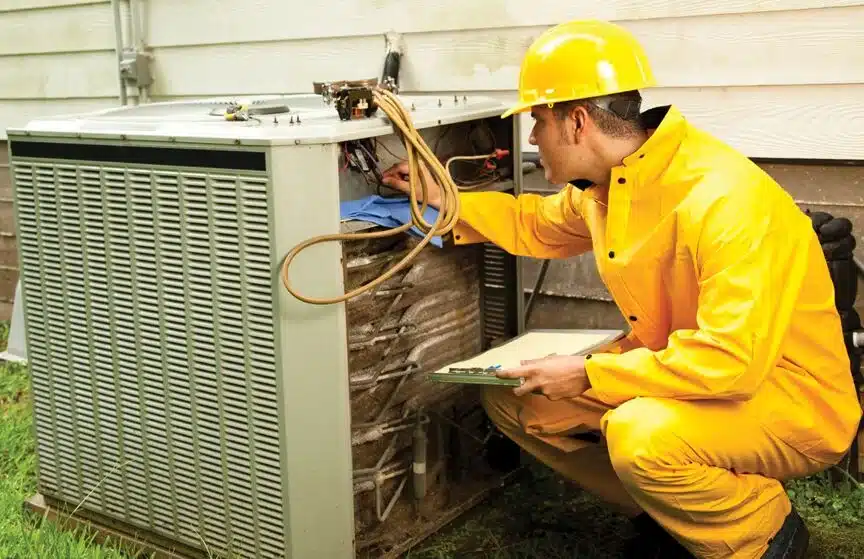
It’s 2 p.m. on a Saturday in July. The thermostat in your Plano living room reads 81 degrees. Your AC has been running for four hours straight. Cold air should be pouring from the vents, but the air feels lukewarm. Something inside your system has failed. The most likely culprit sits in your indoor unit, behind a metal panel you’ve probably never opened.
That component is the evaporator coil. It’s the part of your air conditioning system that actually absorbs heat from the air inside your home. Without it, refrigerant has nothing to do. Your compressor works for nothing. And your house stays hot.
How an Evaporator Coil Works
The evaporator coil sits inside your indoor unit — usually mounted on top of your furnace or inside the air handler. It’s a set of copper or aluminum tubes bent into a U-shape, with thin metal fins stacked tightly around them.
Cold, liquid refrigerant enters the coil through a metering device called a TXV (thermostatic expansion valve). Your system’s blower pulls warm air from your home and pushes it across those fins. As the warm air passes over the coil, the refrigerant absorbs the heat and changes from liquid to gas. The now-cooled air continues through your ductwork and into your rooms.
That gas travels to the outdoor unit, releases the heat it absorbed, and cycles back inside as a liquid. The evaporator coil is where the cooling actually happens. Every other component exists to support that one heat exchange.
In winter, if your system includes a heat pump, this process reverses. The evaporator coil releases heat into your home. Either way, the coil is doing the heavy lifting.
What Damages an Evaporator Coil
Evaporator coils fail for a handful of predictable reasons. Most of them trace back to two things: restricted airflow and outdoor neglect.
Dirty air filters are the most common cause of coil problems. A clogged filter chokes the airflow your coil needs. DFW homes run AC from April through October. That’s roughly 2,200 hours per year. The filter collects dust, pet hair, and pollen fast. When airflow drops, the coil’s surface temperature falls below freezing. Ice forms on the fins. Moisture drips where it shouldn’t. Over time, the coil corrodes.
A $6 filter from any hardware store prevents most of this damage. Change it every 30 to 60 days during cooling season. Skipping filter changes for three or four months is the fastest way to shorten your coil’s life.
The outdoor condenser coil affects the indoor evaporator coil. Your AC is a closed loop. When the condenser coil outside gets caked with cottonwood fluff, leaves, or grass clippings, it can’t release heat properly. Refrigerant pressures climb. The compressor works harder. And the evaporator coil inside bears the stress. With 30% airflow loss at the condenser, the evaporator coil can freeze solid. Even a clean filter indoors won’t prevent it.
Other causes include refrigerant leaks from vibration or factory defects. Corrosion from volatile organic compounds (VOCs) is common in newer, tightly built homes. Simple age plays a role too. Copper evaporator coils in homes built before 2010 are prone to formicary corrosion. That’s a pattern of tiny pinholes caused by acid exposure over years.
Signs Your Evaporator Coil Is Failing
You won’t see your evaporator coil without opening a panel. But you’ll notice the symptoms.
Your AC runs for hours without bringing the house below 78 degrees. Water pools around the base of your indoor unit. Your energy bill spikes $40–$80 above your normal July average. The air from your vents feels room temperature. Ice forms on the refrigerant lines leading into the house.
Any of these warrants a diagnostic call. A Houk technician can measure superheat and subcooling at the coil. Those readings confirm whether the evaporator is the problem. The issue could also be a failed TXV, low refrigerant, or a dying blower motor. A diagnostic visit across Dallas–Fort Worth typically takes under an hour.
When to Repair vs. Replace Your Evaporator Coil
A coil repair usually means fixing a refrigerant leak. A technician locates the leak, patches or brazes it, pressure-tests the coil, and recharges the system. Cost for a straightforward repair runs $400–$900, depending on refrigerant type and how accessible the coil is.
Replacement means removing the old coil and installing a new one matched to your outdoor unit. Installed cost runs $1,200–$2,500 in the DFW market. Price depends on system size, coil type, and installation complexity. Financing can help spread the cost if the repair catches you off guard.
Here’s how to decide.
Your system is 10 years old or older. A residential AC in Texas lasts 12–15 years with regular AC maintenance. If your system is already past the 10-year mark and the coil fails, the math usually favors full AC replacement. You’ll get a matched system, a full manufacturer warranty, and higher efficiency. Spending $900 on a coil for a 12-year-old system is risky. That compressor could fail next year. Put the money toward new equipment instead.
Your system’s efficiency is outdated. SEER (Seasonal Energy Efficiency Ratio) measures how efficiently your AC converts electricity into cooling. Since January 2023, new systems in Texas must meet a minimum of 15 SEER. Under updated testing, that’s 14.3 SEER2. If your current system is rated 10 or 12 SEER, the evaporator coil is part of that older design. Replacing the coil alone won’t bring the system up to modern standards. A full replacement will.
Your system uses R-22 refrigerant. R-22 production ended in the United States in January 2020 under the EPA’s phaseout of ozone-depleting substances. Technicians can still service R-22 systems using reclaimed refrigerant. But the supply is limited and the price reflects it. A single R-22 recharge can cost $100–$150 per pound. Most 3-ton residential systems hold 6–12 pounds. If your evaporator coil leaks on an R-22 system, replacement is almost always the smarter financial move. A modern R-410A or R-454B system will cost less over five years.
Your system is under 8 years old with a single leak. In this case, AC repair usually makes sense. One coil leak on a newer system is a fixable problem. Your technician can repair the leak, recharge the system, and confirm it’s holding pressure. Most manufacturer parts warranties cover the coil for 5–10 years, depending on brand and registration.
How to Protect Your Evaporator Coil
Most coil failures are preventable. Four habits make the biggest difference.
Change your air filter every 30–60 days during the cooling season. Most DFW homes run AC from late March through mid-October. That’s six to eight filter changes per year. Buy filters in bulk. Set a phone reminder. This one step prevents more AC repair calls than any other.
Keep the outdoor condenser clear. Trim vegetation to at least 24 inches on all sides. Hose down the fins gently once a season to remove dirt buildup. A clean condenser keeps system pressures where they belong and takes stress off the evaporator coil inside.
Schedule two tune-ups per year — one before cooling season, one before heating season. A tune-up includes coil inspection, refrigerant pressure checks, and blower performance testing. Houk’s maintenance program covers both visits, plus priority scheduling and repair discounts. Systems that get regular maintenance last two to five years longer than those that don’t.
Watch your energy bills. A sudden spike of $40 or more in a single month often signals a coil or refrigerant issue. Look for jumps with no change in usage patterns. Catching it early usually means a $400 repair. Catching it late can mean a $2,000 replacement.
What to Do Next
If your AC is running but your house still feels warm, or you’ve noticed water pooling near your indoor unit, those are signs worth checking. A technician can diagnose the problem in under an hour and give you a straight answer on repair versus replacement.
Book a diagnostic call online at houkac.com/contact or call us directly. We run same-day service calls across Dallas–Fort Worth. If the coil is the problem, we’ll walk you through every option before anything gets installed.
────────────────────────────────────────────────────────────
Sources and Further Reading
- EPA Phaseout of Ozone-Depleting Substances: epa.gov/ods-phaseout
- U.S. Department of Energy — SEER2 Efficiency Standards: energy.gov
• Trane — What Is R-22 and Why Is It Being Phased Out: trane.com