

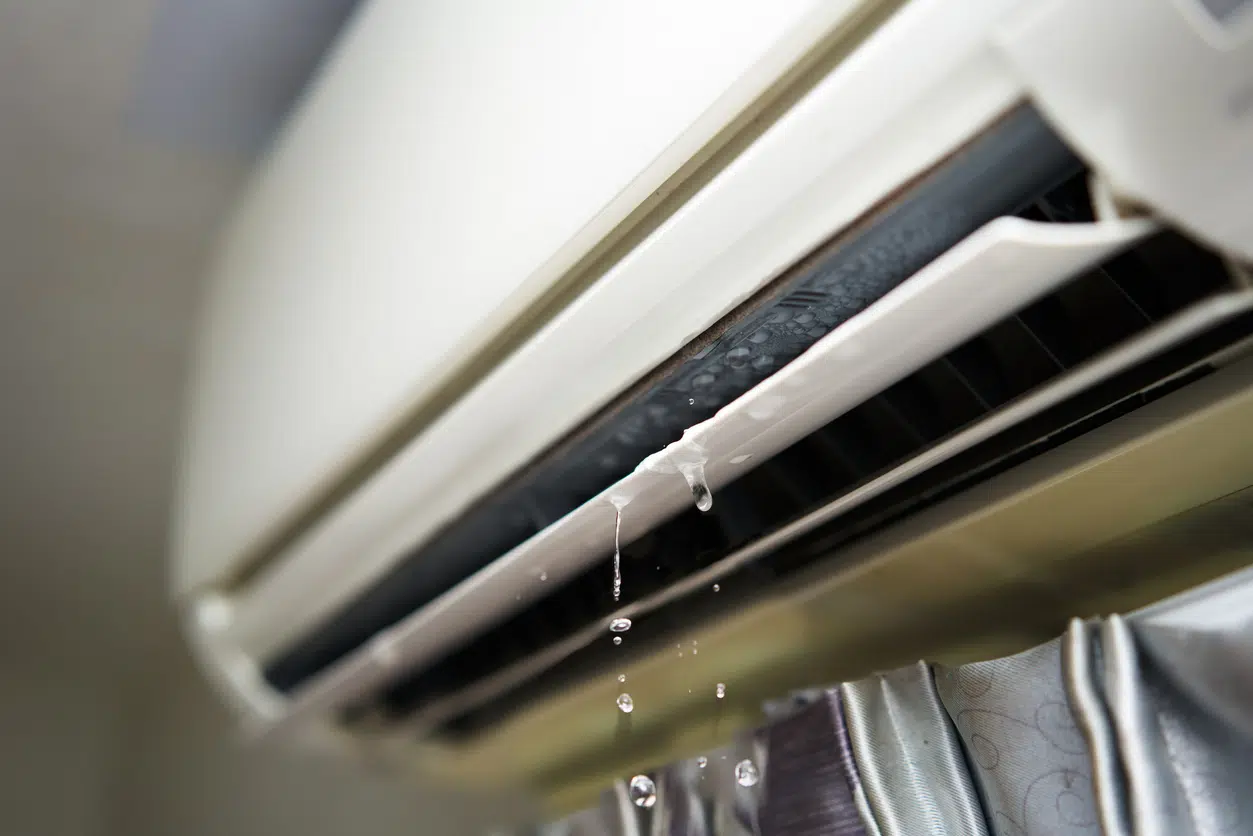
Water where there shouldn’t be, near the indoor unit, under the outdoor condenser, somewhere it wasn’t yesterday, is one of those problems that’s hard to ignore and hard to diagnose at a glance. Some of it is your system doing exactly what it’s designed to do, while some of it is a clear sign something’s failing. The difference usually comes down to where the water is and what’s happening around it.
TL;DR: AC Water Leaking Explained
- A steady drip from the outdoor condensate line is normal, especially on humid days
- A puddle indoors, or water pooling near the outdoor unit with no active drip, is not
- The two most common indoor culprits are a clogged drain line and a cracked or overflowing drain pan
- A frozen evaporator coil that’s melting is a symptom, not the root problem, and it needs a real diagnosis
- Some causes are a five-minute fix; others need a technician with EPA Section 608 certification
Is Water Around an AC Unit in Summer Normal?
DFW summers push a lot of moisture through your AC system, so water around an AC unit in summer is more common than in cooler months. Your system is pulling humidity out of the air constantly, and that moisture has to go somewhere. Some of what looks alarming is actually your system working as intended.
Wondering what counts as normal moisture in the first place? Our guide on what indoor humidity is actually normal in a DFW summer breaks down the numbers your system is working against.
The difference between normal and not usually comes down to location and pattern. Water outside near the condensate line, tied to how hot and humid the day is, is normal. Water indoors, or water outside that shows up even when the system isn’t actively cooling, is not.
Normal Condensate: Your AC Working As It Should
Central AC systems remove humidity as a byproduct of cooling. Warm, humid air passes over a cold evaporator coil, moisture condenses out of it, and that water drains away through a dedicated line, usually a white PVC pipe near your outdoor unit. On a hot, humid North Texas afternoon, a steady drip or trickle from that line is expected, not a warning sign.
The fix: Nothing to fix here. No technician needed. If the line is dripping outdoors and nothing is pooling indoors, your system is doing its job.
This is one of several system quirks that sound alarming but aren’t. For more, check out 10 HVAC behaviors that look scary but are completely normal.
A Clogged Condensate Drain Line
Condensate drain lines carry water, and standing water is exactly the environment algae, mold, and sludge like to grow in. Over time, that buildup narrows the line until water backs up instead of draining. When the line clogs completely, water has nowhere to go but back into the drain pan, and eventually onto your floor, attic, or ceiling below.
A clog usually shows up as water pooling near the indoor air handler, sometimes with a musty smell if mold has started growing in the line. Many systems have a float switch that shuts the AC off when this happens, so a clogged line is also a common reason your AC stops cooling with no other warning.
The fix: A wet/dry vacuum at the outdoor end of the line can sometimes work to clear a minor clog. A recurring clog, or one you can’t clear, calls for a technician who can flush the line properly and check for a failing float switch.
A Cracked or Overflowing Drain Pan
The drain pan sits under the evaporator coil and catches condensate before it flows into the drain line. Pans crack with age, especially older metal pans that corrode, or plastic pans that become brittle over years of heat cycling. A cracked pan lets water escape before it ever reaches the drain line, so you’ll see water underneath or around the indoor unit even if the drain line itself is perfectly clear.
An overflowing pan looks similar but isn’t the same problem. The pan itself is fine, but it’s filling faster than it can drain, usually because the line feeding it is already restricted.
The fix. A cracked pan needs to be replaced, which is a job for a technician. If the pan is intact but overflowing, the real fix is clearing whatever’s restricting the drain line beneath it, not the pan itself.
Melting Ice From a Frozen Evaporator Coil
This is the one that catches homeowners off guard, because it doesn’t look like a water problem until it already is one. A frozen evaporator coil doesn’t leak on its own. It’s ice, sitting quietly on the coil, until the system cycles off or ambient heat catches up, and then it melts all at once. What looks like a sudden leak is often several hours of ice finally letting go.
What a Frozen Evaporator Coil Is Trying to Tell You
A coil freezes when something disrupts the normal balance between airflow and refrigerant temperature. The coil is designed to run cold, but not cold enough to frost over, and when it does, it’s a downstream symptom of one of a few root causes.
- Restricted airflow. A dirty air filter, closed vents, or a failing blower motor all reduce the volume of warm air passing over the coil. Without enough warm air moving across it, the coil gets colder than it should and ice starts to form.
- Low refrigerant. A system running low on refrigerant, usually from a leak, can’t maintain normal pressure. Lower pressure means a colder coil surface, and moisture in the air freezes onto it instead of just condensing off.
- A failing blower or fan motor. If the indoor fan isn’t moving air the way it should, even with a clean filter and full refrigerant charge, the same freeze-up can happen. Heat just isn’t being carried away from the coil fast enough.
The melted-ice puddle is the last step in that chain, not the first. Fixing the puddle without fixing the airflow or refrigerant issue behind it means the coil just freezes again on the next cycle.
The fix: Turn the system off and let the ice melt fully before running it again; running a frozen coil can damage the compressor. Beyond that, this one needs a technician. Diagnosing whether it’s airflow, refrigerant, or a motor issue requires equipment most homeowners don’t have, and any refrigerant work legally requires EPA Section 608 certification.
How to Tell Which One You’re Looking At
| What you’re seeing | Likely cause |
| Steady drip outside, tied to hot/humid days | Normal condensate |
| Puddle indoors near the air handler, musty smell | Clogged drain line |
| Water under/around the unit, even when the drain line is clear | Cracked or overflowing pan |
| A sudden puddle after the system’s been running hard, no clog found | Melting ice from a frozen coil |
So You’ve Diagnosed the Puddle: Now What?
Knowing the cause is only half the equation. The other half is knowing what happens if you ignore it. A clog left alone can back up into your ceiling. A cracked pan won’t fix itself. And a coil that’s frozen once will freeze again until the actual cause gets addressed.
None of that means every drop of water is an emergency. But once you’ve matched what you’re seeing to a cause, you’ll know whether it’s a wait-and-watch situation or one worth a call today.
Spot Water Around Your AC Unit in DFW? Schedule a Maintenance Visit Today
Serving the Dallas-Fort Worth area since 1962, Houk AC has helped generations of homeowners figure out exactly what’s behind a leaking system, whether it’s a clog or a coil that needs a real diagnosis. Schedule service today, or ask about Houk’s Maintenance Program, where a 27-point inspection, 15% discount on repairs, FastTrack priority scheduling, no after-hours charges, and a free diagnostic within 30 days help catch these issues before they end up on your floor.